
What are betel nut products and preparations?
Betel nut is the seed of the fruit of the areca palm. It is also known as areca nut.
The product or preparation depends on the customs in the country of origin. For example, betel nut products and preparations can be known as ‘paan’ or ‘supari’ (India and Pakistan), ‘bin lang’ (China), ‘puwak’ (Sri Lanka) and ‘buai’ or ‘daka’ (Papua New Guinea).
How prevalent is betel nut use?
Around 10% of the world’s population (600 million people) chew betel nut in some form. Betel nut is the 4th most widely used psychoactive substance in the world, after nicotine, alcohol and caffeine.
Betel nut plays an important role in social customs, religious practices and cultural rituals in the Asia-Pacific region. Betel nut use is common in India, Sri Lanka, Maldives, Bangladesh, Myanmar, Taiwan and several islands in the South Pacific region, including Papua New Guinea. Betel nut is also used in Thailand, Indonesia, Malaysia, Cambodia, Vietnam, Philippines, Laos, China and in the migrant communities from these countries.

In Australia, betel nut is mostly used amongst those born in the Indian subcontinent and South-East Asia, including refugees.
Betel nut is used for ceremonial and recreational reasons3,5, including social and cultural inclusiveness, improved mood, alertness, as a digestive aid after meals, mouth freshener, as well as for it’s pleasant smell and taste.
How is betel nut used?
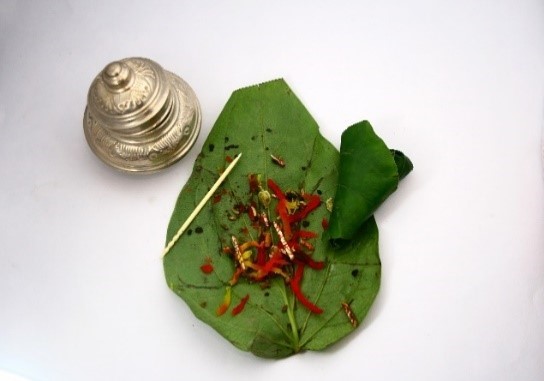
Betel nut can be used on its own or as a mixture of various ingredients, known as ‘betel quid’. In its most basic form, betel quid consists of betel leaf, betel nut, slaked lime (calcium hydroxide), various spices and is often mixed with tobacco.
Betel quid may be self-prepared with the ingredients wrapped in the betel leaf, or commercially made with the powdered ingredients packaged in tins or sachets. The quid is placed in the mouth (usually between the gum and cheek) and may be chewed, or remain in contact with the oral mucosa.
Why is it a concern in NSW?
Betel nut has been declared as a group 1 carcinogen to humans. The active ingredient in betel nut, arecoline, is a Schedule 4 poison. The number of people presenting with health issues associated with betel nut use is increasing in Australia.
People migrating from countries where betel nut is traditionally used will often continue this practice. A high proportion of people migrating to NSW are from countries where the practice is common, including India, China, Philippines, Vietnam, Nepal and Pakistan.
People who use betel nut products and preparations may be unaware of their harmful effects.
What are the health issues associated with betel nut use?
Use of betel nut products and preparations are linked with a range of short- and long-term health issues.
Use of betel nut is known to cause:
- increase in heart rate, blood pressure, sweating and body temperature
- feelings of well-being and alertness
- discoloured teeth and gums
- mouth ulcers and gum disease
- dependence on betel nut
- oral precancerous lesions, including erythroplakia and leukoplakia
- oral submucous fibrosis
- oral cancers (predominantly of the lip, mouth, tongue, and pharynx)
- peptic ulcer
- cardiovascular effects
- increased risk of having a low birth-weight infant.
How do I conduct a brief intervention?
Health professionals can conduct brief interventions with patients who use betel nut. It is recommended that health professionals advise patients:
- of the harms of betel nut use
- to avoid chewing betel quid late at night because it is a stimulant
- to avoid using alcohol, tobacco or other drugs during or after chewing betel quid, due to the associated health risks.
If the patient also uses tobacco products, it is recommended they are referred to Quitline.
For dental practitioners, it is also recommended that they screen for signs or symptoms of oral cancer and provide brief advice to patients who use betel nut.
Safimex company has supplying Dried betel nuts with a good price. If you are interested in these products, please do not hesitate to contact us at info@safimex.com or click on: https://www.alibaba.com/product-detail/Dried-whole-areca-for-export-Dried_11000007677292.html?spm=a2747.manage.0.0.6b8b2c3cr02L3E
Source: NSW Health
SAFIMEX JOINT STOCK COMPANY
Head Office: 216/20a Duong Ba Trac Street, Ward 2, District 8, Hochiminh City, Vietnam.
Tel: (+84)-(28)-3636 2388 | (+84)-(28)-3636 2399 | Website: https://safimex.com/
