
Walk into any pet shop and you’ll find a wall of chews, all of them natural, all of them long-lasting, none of them telling you how they fail. Because everything fails somehow — the useful question isn’t which chew is perfect, it’s which failure you’d rather live with.
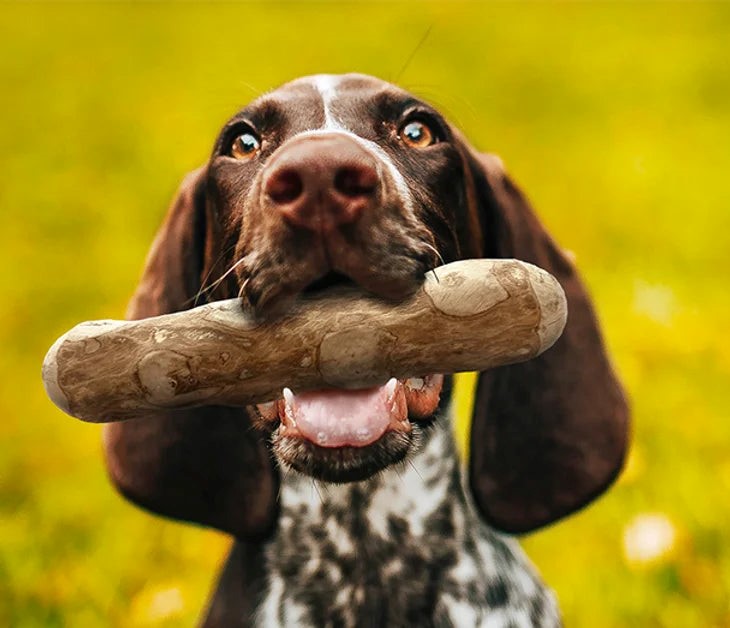
Here’s an honest run through the main options, including where ours loses.
The short version
| Chew | Lasts | How it fails |
| Antler | Very long | Too hard to give — the tooth breaks instead |
| Cooked bone | Varies | Splinters into sharp points. Avoid entirely |
| Rawhide | Medium | Softens, then peels into swallowable chunks |
| Nylon / hard plastic | Very long | Sharp shards, and the shavings don’t break down |
| Rubber | Short to medium | Gets torn up — but rarely hurts teeth |
| Stick off the lawn | Minutes | Splits along the grain into points |
| Coffee wood | Long | Wears into fibres — but it’s still a hard chew |
Antlers
Antlers are the ones we’d argue with hardest, because they look like the responsible choice. Naturally shed, no additives, last for months.
The problem is that they’re often harder than the tooth trying to break them. When a dog clamps down on something that genuinely will not give, the force has to go somewhere, and it goes into the tooth. Vets see enough of these to have a standard name for the injury.
The thumbnail test sorts it quickly: if you can’t dent it with your nail, it’s hard enough to do damage. Most antlers fail that test badly.
Bones
Cooked bones should never be given to a dog. Cooking makes them brittle and they splinter into sharp fragments. This is not a marketing position, it’s the standard veterinary line.
Raw bones are a more genuine debate, with real advocates on both sides. They’re still very hard, they carry bacterial considerations, and they’re messy. Worth a conversation with your vet rather than a paragraph from us.
Rawhide
Rawhide is a by-product of the leather industry, and getting it from hide to chew involves a fair bit of processing that the packaging tends not to dwell on.
Its failure mode is different from the hard chews: rather than breaking teeth, it softens with saliva and peels away in strips. A determined dog can work off a piece big enough to swallow whole, and that’s where the trouble starts.
Nylon and hard plastic
Extremely durable, which is the selling point. But they’re rigid enough to carry the same tooth risk as antler, they can develop sharp edges as they wear, and the material a dog scrapes off doesn’t break down — in the dog or in the bin.
Rubber
Credit where it’s due: for pure tooth safety, a good rubber chew is hard to beat. It flexes, so it can’t fracture a tooth.
The trade-off is that determined chewers get through them, and some dogs simply aren’t interested — there’s no texture to work at. If your dog is happy with rubber and it’s lasting, you don’t need us.
The stick off the lawn
Worth naming, because it’s what most dogs are actually chewing. Free, endlessly available, and the worst option on this list: sticks split lengthways into points, and they’re the reason a lot of dogs end up at the vet with a mouth injury.
Coffee wood — including where it loses
Coffee wood comes from trees that have finished producing beans and would otherwise be cleared and burned. It’s dense hardwood, and it wears into soft fibres rather than staying rigid until something snaps.
That’s the case for it. Here’s the case against, which you won’t find on most product pages:
- It’s still a hard chew. Softer than antler, but not soft. If your dog has had dental work or has existing tooth problems, talk to your vet before buying one.
- It makes a bit of mess. Fine fibres come off as your dog works at it. That’s the design, but it does mean sweeping.
- It’s not for gulpers. A dog that swallows things whole instead of chewing them isn’t a good match for any long-lasting chew.
- It varies. It’s real timber, so colour, grain and shape differ from one to the next.
So which is safest?
If tooth risk is your only concern, rubber wins, and we’ll say so plainly.
If you want something a determined chewer will actually stay with, the honest ranking is: coffee wood, then rawhide with supervision, then antler and nylon a distant last. Cooked bones and lawn sticks aren’t on the list at all.
Whatever you land on, the three rules don’t change: pick a size your dog can’t fit fully in their mouth, supervise every session, and retire it once it’s small enough to swallow.
Looking for a reliable eco-friendly pet product manufacturer?
Contact Safimex today to discover our complete range of sustainable pet products and explore customized OEM and ODM solutions for your brand at info@safimex.com or click at https://www.alibaba.com/product-detail/Wholesale-Coffee-Wood-Dog-Chew-Toy_10000045054817.html?spm=a27gk.ggs-spa.0.0.c97aoVdToVdTE5
Source: Docabu
SAFIMEX JOINT STOCK COMPANY
Head Office: 216/20a Duong Ba Trac Street, Ward 2, District 8, Hochiminh City, Vietnam
Tel: (+84)-(28)-3636 2388 | (+84)-(28)-3636 2399 | Website: https://safimex.com/
